Reproducing the paper
The scripts under scripts/ and the dACESwarms subpackage, which simulates collectives with known interaction rules, produce the dACE content of every figure, table and number of the paper.
julia --project=. -e 'using Pkg; Pkg.instantiate()'The package versions the paper was produced with are in the manifest of version 0.1.2, archived on Zenodo.
Benchmarks
julia -t auto --project=scripts/paper scripts/paper/figures.jl      # fits, Figures 1, 3–5, Table 1, numbers, videos
julia --project=scripts/paper scripts/paper/fig_recovery.jl         # Figure 2 (without SocialNet), from the results of figures.jl
julia --project=scripts/paper scripts/paper/fig_schematic.jl        # Figure 1 alone
julia -t auto --project=scripts/paper scripts/paper/timing.jl          # fit and evaluation times, for reference (macOS only)
julia -t auto --project=scripts/paper scripts/synthetic/chiral.jl      # then fig_chiral.jl: Figure 6
julia -t auto --project=scripts/paper scripts/synthetic/efficiency.jl  # then fig_efficiency.jl: Figure 7
julia -t auto --project=scripts/paper scripts/synthetic/stochastic.jl  # then fig_selfpropulsion.jl: Figure 8
Figures go to scripts/paper/figures/, or to a directory passed as the first argument. The scripts in scripts/synthetic and scripts/realdata write their results to a results/ folder next to them, which the figure scripts read. scripts/paper/replot.jl redraws every figure and rewrites numbers.tex from cached data and results without refitting.
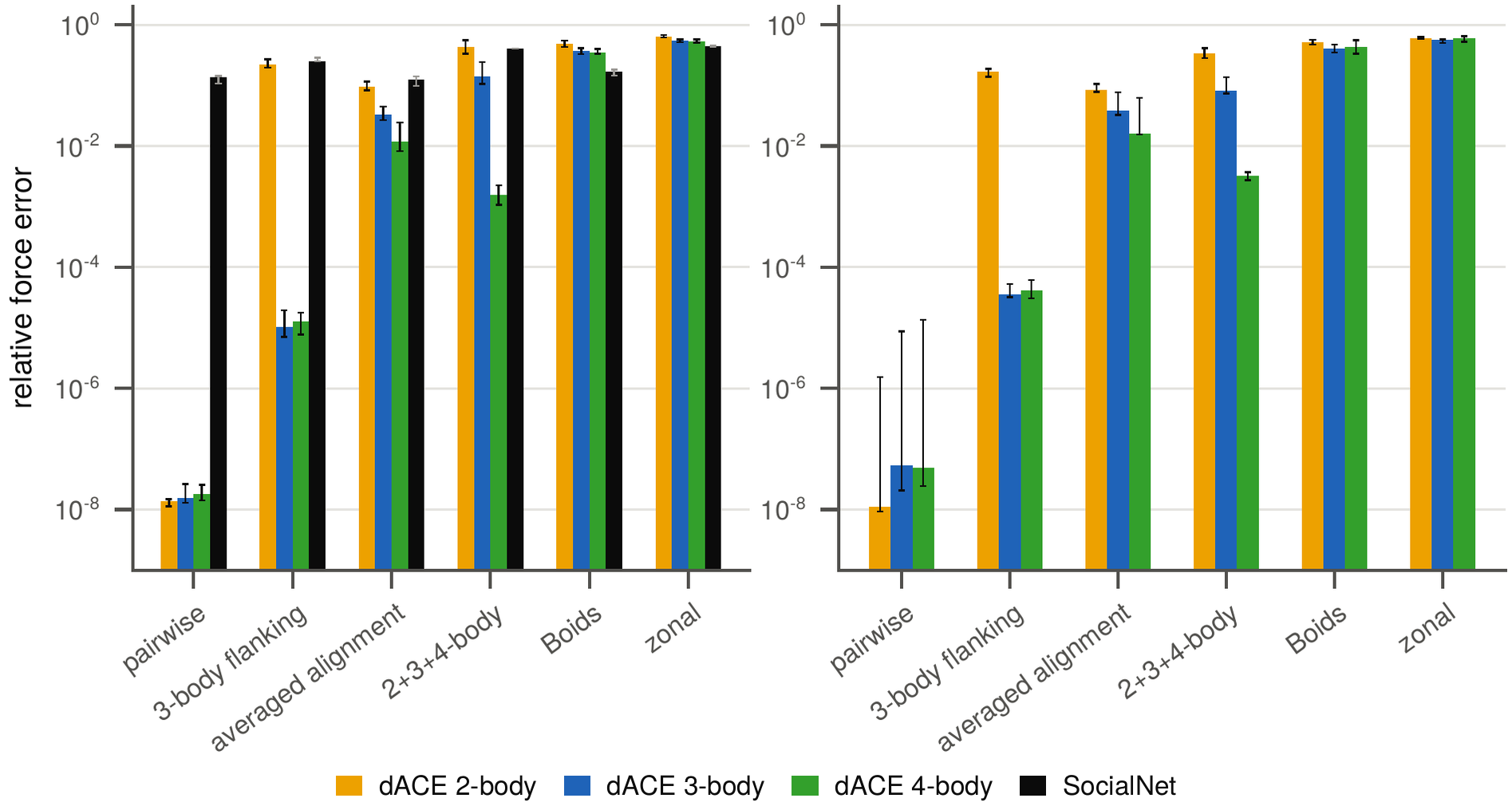
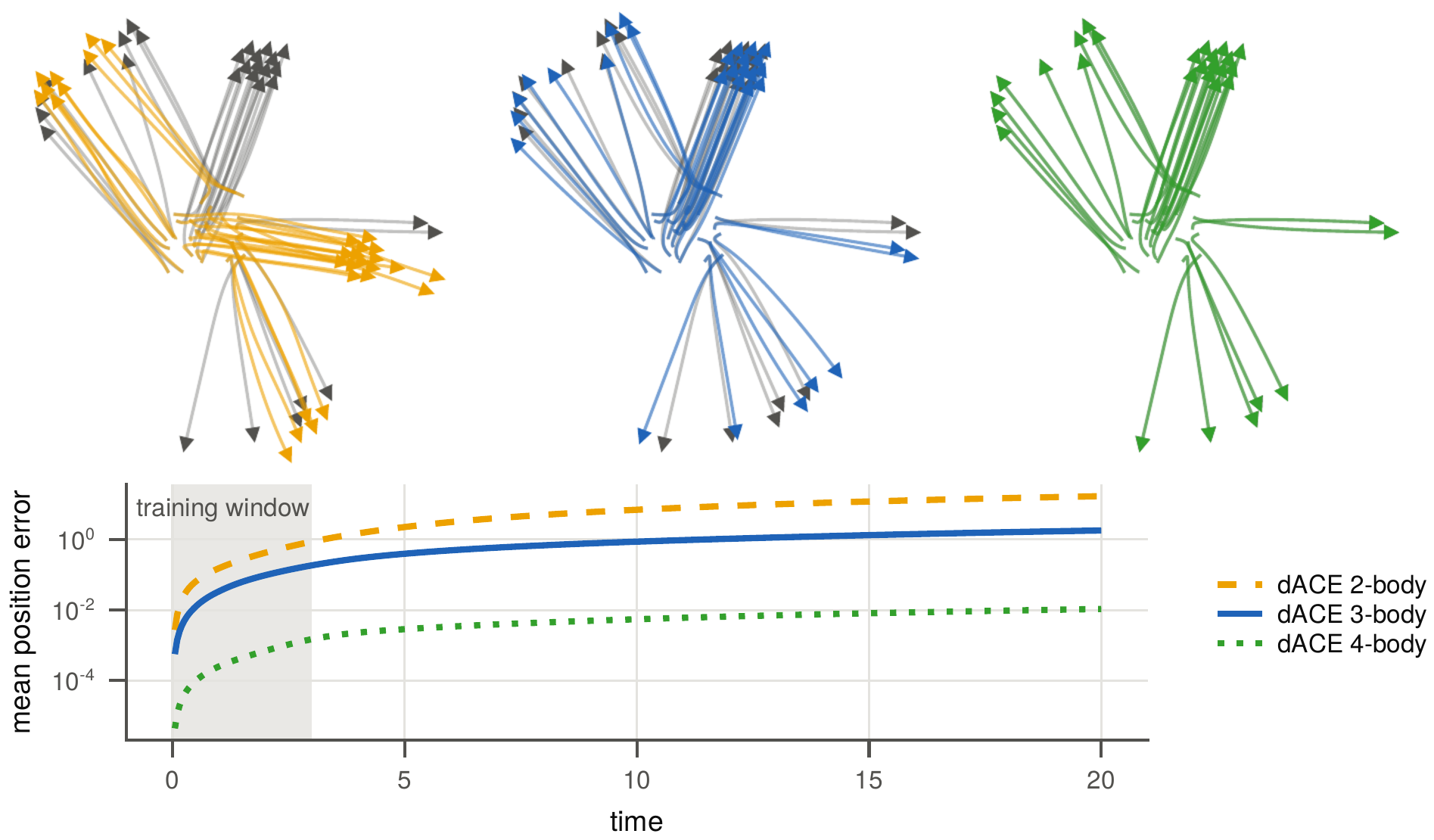
Figure 2, the relative force error of every model on every collective, 2D with SocialNet (left) and 3D (right), and Figure 4, the rollout of the learned 2-, 3- and 4-body models (left to right) on the 2+3+4-body collective with the mean position error below:
The comparison with SocialNet in the paper uses the authors' code and is not part of this repository. The rollout videos of the paper are on figshare, 10.6084/m9.figshare.34831176.
Tracked fish
The tracking data are not part of the repository. Put them under data/ (or the directory in DACE_DATA):
data/shiners_dryad/: the golden shiner trajectories of Davidson et al. (2021), the unpacked Dryad archive 10.5061/dryad.sbcc2fr2h, one folder per trial.compact_shiners()inscripts/realdata/shiners.jlcompacts it once todata/shiners/<trial>.h5.data/zebrafish/<video>.h5: the zebrafish videos of Heras et al. (2019) in the human-validated idtracker.ai tracking of Torrents et al. (2026), thezebrafish_<fish>_<video>.npyfiles of the benchmark data linked from idtracker.ai (Google Drive), converted byscripts/realdata/convert_zebrafish.py. The original tracking of the 2019 paper (Google Drive) goes todata/zebrafish2019/as the second tracking of the cross-tracking test.
SHINER_GAP=0 julia -t auto --project=scripts/paper scripts/realdata/shiners_protocol.jl         # leave one trial out; Figure 10 at gap 0
ZEBRAFISH_GAP=0 julia -t auto --project=scripts/paper scripts/realdata/zebrafish_protocol.jl    # leave one video out, cross-tracking
CONSISTENCY_DATA=shiners julia -t auto --project=scripts/paper scripts/realdata/consistency.jl   # and zebrafish; then fig_realdata.jl: Figures 9, 10
SHINER_GAP and ZEBRAFISH_GAP take the gaps of the paper (0, 3, 6 frames), SHINER_R and ZEBRAFISH_R the cutoffs in body lengths (defaults 3 and 8).
Installing the simulator separately
using Pkg
Pkg.add(url="https://github.com/TSGut/dACE.jl", subdir="lib/dACESwarms")
Tests
julia --project=. -e 'using Pkg; Pkg.test()'
julia --project=lib/dACESwarms -e 'using Pkg; Pkg.test()'